The tariff war between Europe and the United States:
tensions, strategies, and consequences
An escalating economic conflict
Trade relations between the European Union and the United
States are going through a moment of growing tension. The
so-called “tariff war” has become one of the main areas of
concern for global markets in 2026.
What began as isolated trade disputes has evolved into a
broader confrontation involving technology, industry, and
economic strategy.
What is at stake?
At the center of the conflict are the tariffs imposed by
both sides on key products. The United States has applied
measures aimed at protecting its industry, while Europe
has responded with similar actions.
The most affected sectors include:
automotive industry
technology and digital products
steel and heavy manufacturing
These measures are disrupting trade flows and increasing
costs for businesses and consumers.
Beyond trade: technology and power
Although the conflict is presented as a trade dispute, it
actually reflects a deeper struggle for economic and
technological control.
Europe seeks to:
reduce its dependence on US technologies
strengthen its digital sovereignty
develop its own solutions in strategic sectors
For its part, the United States is trying to maintain its
global leadership in innovation and trade.
Impact on the markets
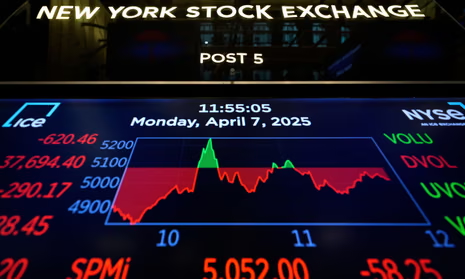
Financial markets have reacted with volatility to these
tensions. Investors are watching closely for any sign of
escalation or negotiation.
The main consequences include:
stock market fluctuations
changes in commodity prices
uncertainty in international investments
Companies in the middle of the conflict
Multinational companies find themselves in a complex
position. Many operate in both markets and must adapt
quickly to new regulations and costs.
This has led to:
supply chain restructuring
searching for new markets
investment in local solutions
Towards a new economic era?
Some analysts believe that this tariff war could mark the
beginning of a new phase in the global economy,
characterized by:
greater regionalization of trade
strategic economic alliances
less dependence on external markets
Possible scenarios
The future of the conflict will depend on several factors:
political negotiations
internal economic pressure
evolution of the global context
Scenarios could include:
agreement and reduction of tensions
escalation with greater restrictions
a temporary balance without a definitive solution
Conclusion
The tariff war between Europe and the United States is
much more than a trade dispute. It represents a shift in
the balance of global economic power.
While both blocs seek to protect their interests, the
impact extends to businesses, markets, and investors
worldwide. The outcome of this conflict could redefine the
rules of international trade in the coming years.
In 2025, entrepreneurship is defined by rapid
technological change, global competition, and
a growing emphasis on purpose-driven business.
Artificial intelligence, remote teams, digital
finance, and...
In today’s digital economy, programming is no
longer a niche skill reserved for software
engineers. It is a core competency across
industries, powering innovation in...
In 2025, the worlds of business, investing,
and technology are more interconnected than
ever. Entrepreneurs and professionals who
understand not just markets but also the...
Successful investing is rarely the result of
luck. In 2025, financial markets are shaped by
global uncertainty, rapid technological
innovation, inflationary pressures, and new
asset...
In an increasingly competitive and
technology-driven world, long-term career
success depends on more than formal education
or technical skills alone. Professionals who
consistently grow are...
Lead In January 2024, following the
court-ordered release of thousands of pages
commonly referred to as the “Jeffrey Epstein
files,” data analysts and investigative
journalists...